
No products in the cart.
Cubicles and Office Furniture
Office Cubicle Layout Guide
02
Apr
Apr
If you are planning an office and trying to figure out how many workstations will actually fit in your space, you are not alone. Layout planning is one of the most common questions we get from customers before they order — and getting it wrong either wastes expensive square footage or leaves you with a cramped, non-compliant office. This guide breaks down exactly how to plan your cubicle layout, from density calculations to aisle widths to real worked examples.
The quick formula: take your total room square footage, subtract roughly 20% for aisles and common areas, then divide by 40–50 square feet per person. This gives you a realistic maximum headcount for the space.
Understanding How Office Space Is Measured
Before planning your cubicle layout, you need to know the difference between gross square footage and usable square footage:
- Gross square footage — the total floor area of the room including walls, columns, and any obstructions.
- Usable square footage — the area actually available for furniture, typically 80–85% of gross.
- Net workstation area — the space for cubicles and chairs only, typically 60–70% of gross after aisles.
For planning purposes, always work from usable square footage. If your room is 2,000 sq ft gross, plan for approximately 1,600–1,700 sq ft usable.
How Many Cubicles Fit? The Density Guide
| Cubicle Size | Sq Ft Per Person | People Per 1,000 Sq Ft | Best Configuration |
|---|---|---|---|
| 4×2 (call center) | 35–40 sq ft | 14–18 people | Back-to-back packed |
| 5×5 | 40–45 sq ft | 12–14 people | Quad or packed |
| 6×6 | 50–55 sq ft | 10–12 people | L-shape or quad |
| 6×8 | 60–65 sq ft | 8–10 people | L-shape or U-shape |
| 8×8 (executive) | 75–90 sq ft | 6–8 people | Private office style |
These figures already account for a reasonable share of aisle space. Dense call-center layouts push toward the top end of the range per 1,000 sq ft; executive or client-facing layouts push toward the bottom.
Aisle Width Requirements
Aisles are the most commonly underestimated part of office planning. Too narrow and your space feels cramped and can fail accessibility requirements. The minimum standards are:
- Primary circulation aisles (main walkways): minimum 60 inches (5 feet) wide.
- Secondary aisles (between cubicle rows): minimum 44 inches wide for ADA compliance.
- Service aisles (behind back-to-back rows for cable access): minimum 36 inches wide.
If your layout includes any path a wheelchair needs to travel — entrances, restrooms, break rooms — that path needs the full 60-inch primary aisle width, not the tighter secondary minimum.
5×5 vs 6×6: Which Size Should You Choose?
This is the single most common sizing decision customers face. Here is how to think about it:
- Choose 5×5 when headcount density matters most — call centers, data entry teams, or any role that is primarily computer-based with minimal paper storage or in-person meetings at the desk.
- Choose 6×6 when the role needs more surface area — two monitors plus paperwork, occasional visitors pulled up to the desk, or storage for reference materials.
The jump from 5×5 to 6×6 costs roughly 20% more space per person but is often worth it for roles where the workstation is used all day, every day, for years. For pure headcount maximization on a budget, 5×5 remains the standard.
Worked Example: Planning a 2,500 Sq Ft Office
Let’s walk through a real planning scenario. Say you have 2,500 sq ft gross:
- Usable square footage at 82%: approximately 2,050 sq ft.
- At 6×6 density (50–55 sq ft/person including aisle share): roughly 37–41 workstations.
- At 5×5 density (40–45 sq ft/person): roughly 45–51 workstations.
From there, subtract space for any private offices, a break room, conference room, or reception area — each of these eats into your usable total before you divide by workstation density. A single 12×14 conference room, for example, removes about 168 sq ft, or roughly 3–4 workstations worth of space at 6×6 density.
Common Layout Mistakes to Avoid
- Measuring gross instead of usable square footage — this alone causes most over-optimistic headcount estimates.
- Forgetting service aisles behind back-to-back rows — cable access and chair clearance both need this space, and it is easy to leave out of an initial sketch.
- Ignoring column and HVAC obstructions — a floor plan looks clean on paper until a support column lands in the middle of a planned row.
- Sizing every workstation the same — mixing 5×5 for high-density teams with a few 6×6 or 8×8 stations for managers is usually more space-efficient than a single uniform size across the whole floor.
Planning an Office Cubicle Layout Around Columns, Windows and Cores
Density calculations assume a clear rectangle. Real floors are not clear rectangles, and the difference between the theoretical count and what actually fits is almost always explained by three obstructions.
Columns. Structural columns sit on a grid, often 20 to 30 feet apart, and they rarely align with a workstation grid. The usual solution is to absorb a column into the corner of a workstation or into a panel run rather than fighting it, which costs a fraction of a seat instead of a whole one. Fighting the grid to keep every workstation identical is how offices lose six or eight seats on a floor.
Windows. The instinct is to put workstations against the glass. The better office cubicle layout usually runs circulation along the window line and places workstations inboard, so daylight reaches the middle of the floor instead of being blocked by a wall of panels at the perimeter. Where workstations do meet windows, keep panel height down or specify glazed tops.
The core. Lifts, stairs, washrooms and risers generate traffic. Workstations immediately adjacent to a core entrance are the least popular seats in any building, and planning a layout that puts six people directly outside the washroom door creates a problem that no amount of panel height will fix. Use that zone for storage, printers, or a break area.
Power and Data in an Office Cubicle Layout
Where power enters the floor constrains the layout more than most planners expect. A panel run carries power along its base, and that run has to reach a building feed somewhere: a floor box, a wall outlet, or a ceiling drop.
Two consequences follow. First, long runs far from a feed point may need more than one connection, which is additional electrical work. Second, an office cubicle layout that looks efficient on paper can become expensive if it puts every pod in the middle of a floor with feeds only at the walls.
The practical approach is to overlay the existing power and data points on the floor plan before placing a single workstation, then build panel runs that connect naturally to them. On a floor with a raised access floor or a regular grid of floor boxes this is straightforward. On a slab-on-grade floor with perimeter power only, it shapes the entire plan.
Count receptacles honestly while you are there. A modern workstation typically needs four: two for the computer and monitors, one for a phone or dock, one spare. Older panel systems were specified for a desktop and a lamp.
Circulation: Primary and Secondary Paths
Aisle widths get quoted as a single number, but a good office cubicle layout distinguishes between two kinds of path.
- Primary circulation carries people across the floor, from the lift core to the far side. It should be continuous, straight where possible, and wide enough for two people to pass comfortably, which in practice means 48 to 60 inches.
- Secondary circulation serves a pod or a row of workstations and dead-ends there. 36 to 42 inches is sufficient, and using the primary width for every aisle is how floors lose ten percent of their capacity for no benefit.
Check local code for minimum egress widths, which take precedence over any planning preference, and remember that a chair pulled out from a desk occupies part of the aisle. An aisle measured panel-to-panel is not the aisle people actually walk down.
Office Cubicle Layout for Hybrid and Shared Desks
If attendance is genuinely hybrid, planning one workstation per employee wastes floor and money. The planning ratio matters more than the density calculation.
| Attendance pattern | Typical desk ratio | Layout implication |
|---|---|---|
| Fully in office | 1 : 1 | Assigned workstations, personal storage at the desk. |
| Four days a week | 0.9 : 1 | Mostly assigned, a small shared pool. |
| Two to three days | 0.6 – 0.7 : 1 | Shared desks, lockers instead of pedestals, clear-desk policy. |
| One to two days | 0.4 – 0.5 : 1 | Mostly bookable, more meeting and focus space. |
Shared desks change the furniture, not just the count. Personal pedestals give way to a bank of lockers, worksurfaces need to be clear at the end of each day, and monitor arms with a single dock connection become close to essential because nobody wants to re-cable a desk each morning.
The floor area released by a lower ratio should not simply disappear. The offices that make hybrid work put it back as meeting rooms, focus booths and informal space, which are exactly what people come in for.
Phasing a Layout Change in an Occupied Floor
Most reconfigurations happen in a building that people are still working in, which makes sequencing the real constraint.
The workable pattern is to create a decant zone: clear one area completely, build the new layout there, move the first group in, then use the space they left as the next decant zone. Progress is slower than a single weekend blitz but the floor stays usable throughout and there is no hotel bill for a displaced department.
Where a full shutdown is unavoidable, install crews generally work faster and cheaper outside business hours, but overtime rates apply. For anything above roughly 30 workstations, price both approaches rather than assuming the weekend is cheaper.
Whichever route you take, the electrical connection is the item that most often delays occupancy. Panels can go up quickly; getting an electrician scheduled to tie the runs in is what sets the date people can actually sit down.
An Office Cubicle Layout Checklist
- Measure the usable rectangle, not the leased area, and mark every column.
- Plot existing power and data feeds before placing workstations.
- Decide the desk ratio from real attendance data, not headcount.
- Run primary circulation along the window line where the floor plate allows.
- Separate primary aisles from secondary ones instead of using one width throughout.
- Keep workstations away from core entrances and use that zone for shared functions.
- Confirm egress widths against local code before finalising.
- Plan the decant sequence before ordering, not after delivery.
How Long an Office Cubicle Layout Should Last
A layout is a five to seven year decision in most companies, and the ones that age well share a trait: they were planned with a little slack. A floor filled to its theoretical maximum on day one has nowhere to put the next four hires, and the answer is usually squeezing in workstations that break the circulation the plan depended on.
Planning to roughly 85 to 90 percent of maximum density costs a few seats up front and buys two or three years of growth without touching the plan. It also leaves room for the things nobody budgets for at the start: a printer that turns out to need its own alcove, a team that needs to sit together, a piece of equipment that arrives larger than expected.
The other durability factor is standardisation. An office cubicle layout built from one workstation size and two panel heights can be rearranged almost indefinitely, because every part fits everywhere. One built from five footprints is effectively frozen, since moving anything means the parts no longer line up.
How much space does one cubicle need in an office cubicle layout?
A 6×6 workstation occupies 36 square feet of footprint but consumes 45 to 55 square feet of leased floor once aisles and circulation are counted. Budget the larger number.
What is a realistic office cubicle layout density?
Roughly 125 to 150 square feet per person for 6×6 workstations including circulation and shared space, and 100 to 125 for 5×5. Call centres using 4×4 can reach 80 to 100.
Should an office cubicle layout put desks against the windows?
Usually not. Running circulation along the glass and placing workstations inboard lets daylight reach the middle of the floor rather than stopping at a wall of panels.
How much slack should an office cubicle layout leave for growth?
Plan to about 85 to 90 percent of maximum density. Filling a floor completely on day one leaves no way to absorb new hires without breaking the circulation.
Getting It Right for Your Space
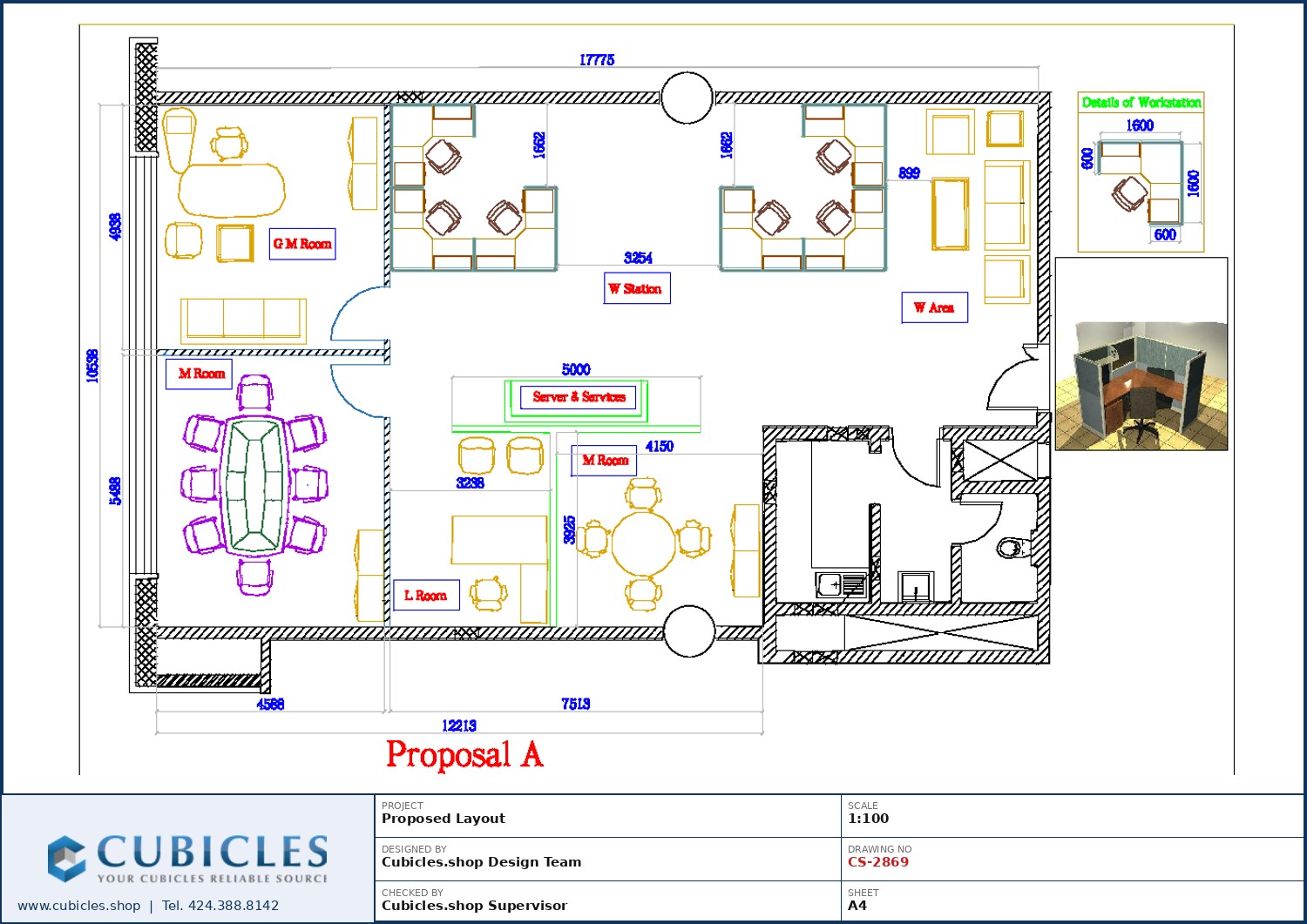
Layout planning interacts with ceiling height, window position, electrical drops, and how the space is actually used day to day. It is worth ten minutes of thought before ordering rather than guessing from a floor plan sketch alone.
Send us your floor plan and we will return a scaled layout at no charge, including a recommended configuration and workstation count based on your actual dimensions. Start at design support, or call 424.388.8142.
Configuration Types Explained
Beyond size, the shape of the cluster itself affects both density and how teams interact:
- Back-to-back (packed) rows — the most space-efficient layout, ideal for call centers and high-density teams. Panels run in straight rows with a shared service aisle behind each pair of rows.
- Quad configurations — four workstations arranged around a shared corner, common in 5×5 and 6×6 layouts. Slightly less dense than straight rows but gives each person a semi-enclosed corner.
- L-shape clusters — workstations arranged in an L around a central point, balancing density with a more open, collaborative feel.
- U-shape clusters — typically used for larger stations (6×8, 8×8) where more surface area and a partially enclosed feel matter more than raw density.
Most offices end up mixing configurations — packed rows for a call-center-style team, quad or L-shape clusters for general admin, and standalone larger stations for managers.
Ceiling Height and Lighting Considerations
Layout planning is not only a floor-plan exercise. Ceiling height affects how tall your panels can go before the space starts to feel closed-in, and overhead lighting placement should be checked against your planned rows before finalizing a layout — a fixture directly above a panel run does little good if it is not centered over the actual workstations. If your building has exposed ductwork or low clearance in sections of the room, note those areas early, since they sometimes force a shorter panel height or a different row orientation than the rest of the floor.
Frequently Asked Questions
Can I mix cubicle sizes in the same office?
Yes, and it is common. Many offices use 5×5 for high-density teams and 6×6 or larger for managers or roles that need more surface area, all within the same floor plan.
How much does a service aisle actually cost me in space?
A 36-inch service aisle behind a row of 6×6 stations removes roughly the equivalent of half a workstation’s footprint per row — worth factoring in before you count seats.
Do I need to plan around building code, or just ADA?
Both. ADA governs accessible path widths, but your local building and fire code may set additional requirements for egress paths and maximum occupancy — check with your local jurisdiction or building manager before finalizing a layout for a large office.
For standard workstation dimensions see the office cubicle size guide, and to browse cubicles by configuration see our office cubicles category.
Shop Office Cubicles Direct From the Manufacturer
Ready to compare options? Browse our office cubicles, call center cubicles, modular cubicles and cubicle walls, or see all office cubicles for sale. Every order ships new and manufacturer-direct with nationwide delivery. Call 424.388.8142 for a quote.